Temporal Mapper 2
Temporal Mapper 2 (tmapper) is a MATLAB toolbox that turns time-series data
into an attractor transition network — a compact graph that captures the
stable states of a dynamical system and the transitions between them, using
nothing but the time series itself.
It generalizes the original, fMRI-specific Temporal Mapper into a general-purpose tool for characterizing complex dynamics across disciplines and data types.
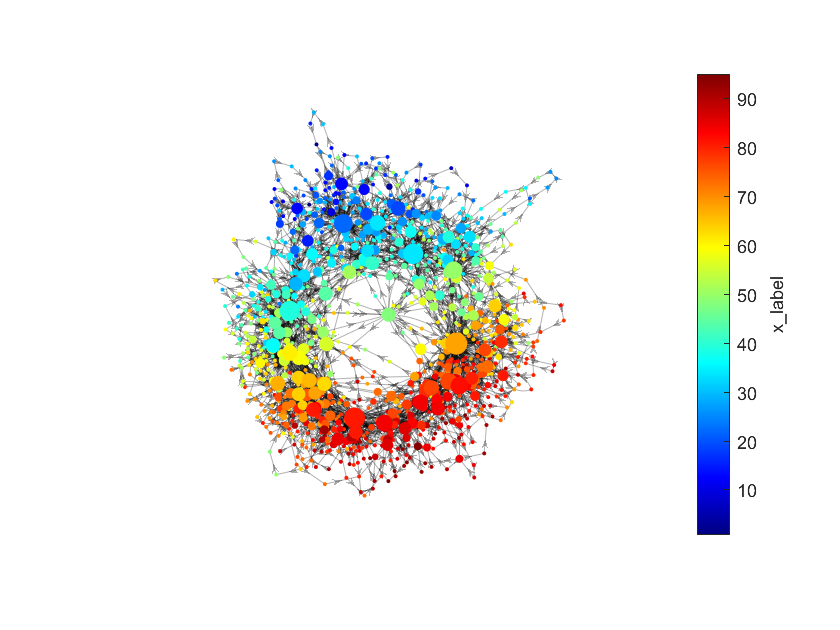
An attractor transition network built by Temporal Mapper from historical East Lansing weather data. You will reproduce this figure in the Quickstart.
What it produces
Given a time series, Temporal Mapper returns a directed graph in which:
- each node is an attractor (a stable state the system settles into),
- the size of a node reflects the local stability of that attractor (how many time points collapse into it), and
- each edge is an observed transition from one attractor to another.
How it works
Under the hood the computation is a two-step pipeline. You can read the full rationale in the paper; the short version is:
Step 1 — spatiotemporal neighborhood graph
Starting from a pairwise distance matrix D between all time points,
tknndigraph builds
a directed k-nearest-neighbor graph with one node per time point, adding
back the temporal (t → t+1) links so the flow of time is preserved.
Step 2 — simplified transition network
filtergraph
contracts time points that sit within a distance d of each other into a
single node. The connected components become the nodes of the final
attractor transition network.
Two parameters do most of the work: k (how many spatial neighbors each
time point may have) and d (the compression threshold — loops shorter than
this are absorbed into a node). The Quickstart walks through
both on real data.
Applications
Because it needs only a multivariate time series, Temporal Mapper is not tied to any one field. It was introduced and validated on simulated and human brain dynamics (fMRI), and has since been applied to social behavior — the moment-to-moment interpersonal dynamics between patient and therapist in psychotherapy, and the naturalistic social behavior of freely interacting animals. See Applications for details and figures.
Where to go next
- Installation — add the toolbox to your MATLAB path and check dependencies.
- Quickstart — build your first transition network end to end, reproducing the figure above.
- Interactive App — the same pipeline, point-and-click, no code required.
- Concepts — what the nodes, edges, and loops mean, and why the two-step construction works.
- Applications — published examples in brain and social dynamics.
Citation
If you use this toolbox in your work, please cite:
Zhang, M., Chowdhury, S., & Saggar, M. (2023). Temporal Mapper: transition networks in simulated and real neural dynamics. Network Neuroscience, 7(2): 431–460.
For the psychotherapy / social-behavior application, see also:
Luo, X., & Zhang, M. (2026). A topological data analysis method for revealing dynamic changes in psychotherapy microprocesses. Frontiers in Psychology, 16: 1711782.