Applications
Temporal Mapper was born as a tool for brain dynamics, but nothing in its construction is specific to neuroscience — it needs only a multivariate time series with distinguishable stable states. This page collects the applications so far — spanning brain activity, human social interaction, and animal behavior — and what they show. For the underlying ideas, see Concepts.
Brain dynamics
The method was introduced and validated in Network Neuroscience.1
Simulated neural dynamics (ground-truth validation). The authors drove a biophysical
network model of 66 brain regions (a reduced Wong–Wang / Wilson–Cowan model) through a
sequence of phase transitions by slowly varying a global coupling parameter G. Because
the model's equations are known, they could compute the true attractor transition
network and check Temporal Mapper against it. Reconstructed from the simulated time series
alone, the network closely approximated the ground truth — and did so better than dynamic
functional connectivity (dFC) or raw BOLD, especially in capturing the asymmetric,
path-dependent structure that reflects the underlying dynamics.
Human fMRI (empirical relevance). Applied to 18 subjects in a continuous multitask
experiment — alternating blocks of rest, working memory, math, and video — Temporal Mapper
(k = 5, d = 2) produced transition networks whose structure tracked the task blocks.
The cognitively demanding tasks (memory and math) dominated the highest-degree, central
nodes, while rest and video dominated the long cycles out on the periphery. Strikingly,
these features were behaviorally predictive: how sharply a subject's network separated
demanding from undemanding tasks predicted their accuracy, reaction time, and missed
trials, and the abundance of intermediate-length cycles tracked slower reactions.
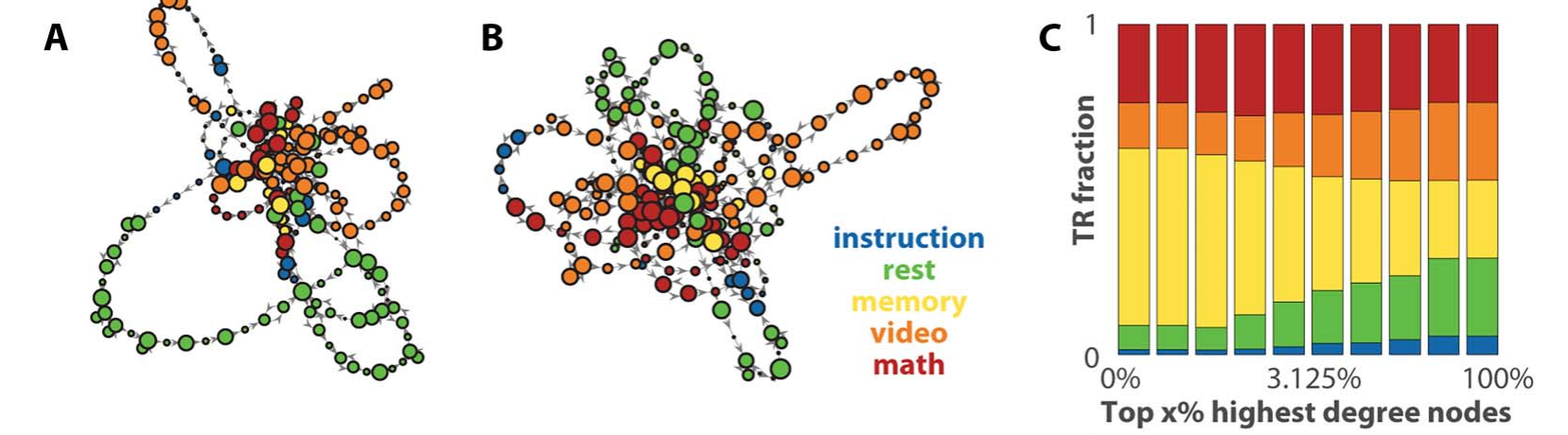
Transition networks from two subjects' fMRI in a continuous multitask experiment, with nodes colored by the dominant task (A, B), alongside the fraction of each task among the top-x% highest-degree nodes (C) — memory and math dominate the central, high-degree nodes. Adapted from Zhang, Chowdhury & Saggar (2023), Figure 5 (CC BY 4.0).
Social and interpersonal dynamics
The most recent application moves Temporal Mapper out of the brain entirely, to the back-and-forth between two people in psychotherapy.2
Here the "state" is a four-dimensional dyadic interpersonal state — the warmth and
dominance of both patient and therapist, rated moment-to-moment (every half second) from
session video using the Continuous Assessment of Interpersonal Dynamics. From these four
time series, Temporal Mapper (k = 7, d = 3) builds one transition network per session,
whose nodes are recurring interpersonal configurations and whose loops are excursions away
from them and back.
Reading the networks with the same vocabulary as the brain work — node size as local stability, loop length as global stability — the study found a clean and clinically meaningful pattern:
- Therapist warmth stabilizes. Higher therapist warmth co-occurred with larger nodes (more locally stable interpersonal states) within sessions, and warmer sessions had shorter loops (more globally stable, less diverse states) across sessions.
- Confrontation ruptures cut both ways. States with high confrontation were locally stable within a session (larger nodes — the dyad dwelt there), yet sessions with more confrontation were globally less stable across sessions (smaller average nodes, longer loops), pushing the dyad to explore a more diverse range of interpersonal states. The authors interpret such states as saddles — attracting locally while repelling toward new territory.
- Withdrawal ruptures were essentially invisible to the network features — consistent with clinical accounts of withdrawal as a diffuse "stalling" rather than a system-level reorganization.
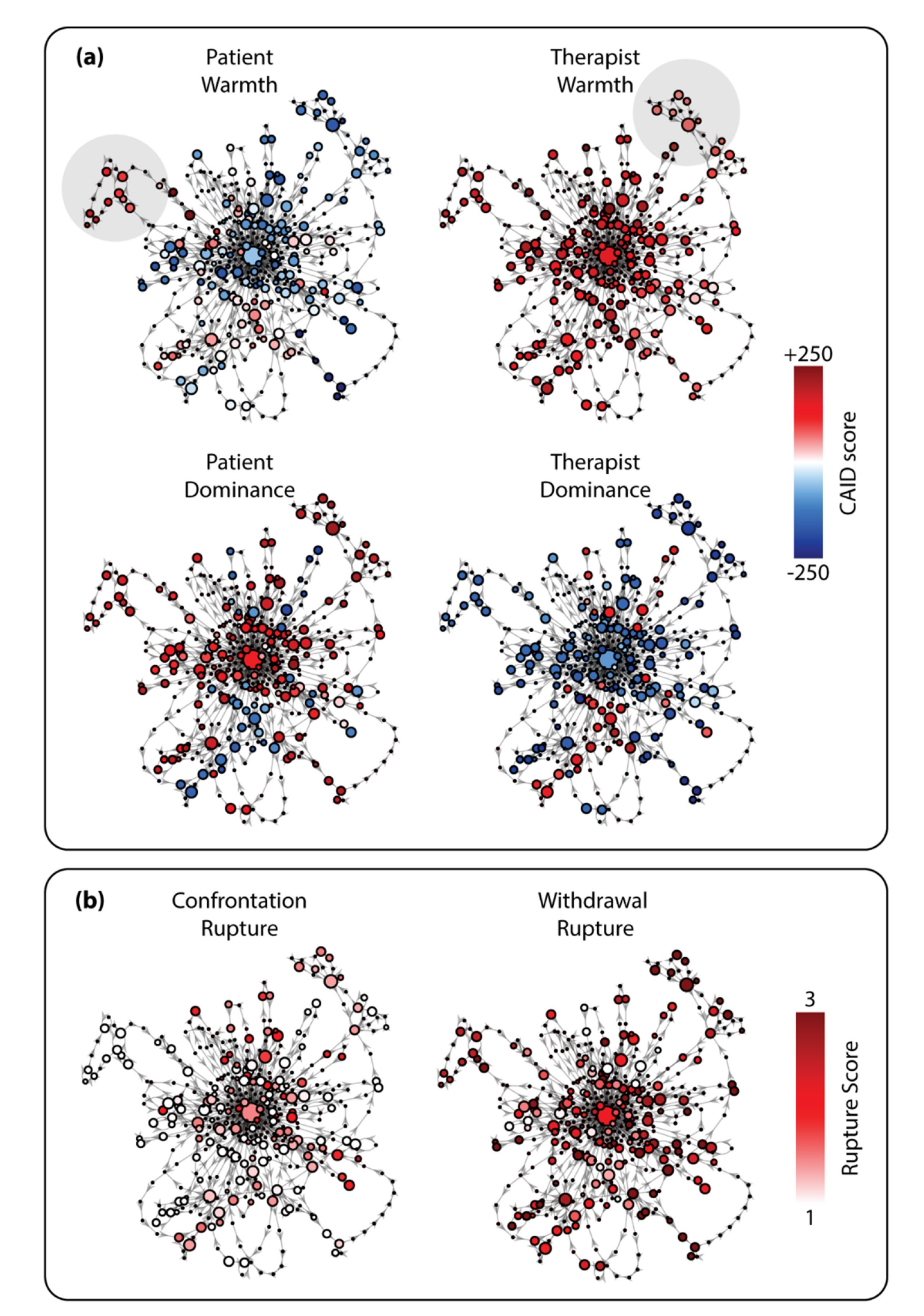
An interpersonal state transition network for a single therapy session, built from the CAID time series alone. Nodes are colored by the average interpersonal-circumplex scores (a — patient and therapist warmth and dominance) and by average confrontation and withdrawal rupture (b). Adapted from Luo & Zhang (2026), Figure 2 (CC BY).
This study is also a template for the broader point: because Temporal Mapper is agnostic to what the variables mean, the same pipeline applies to affective processes, linguistic or physiological signals, and other multimodal streams — anywhere a system dwells in states and occasionally switches between them.2
Naturalistic animal behavior
The newest application (a preprint) pushes Temporal Mapper into naturalistic animal
behavior — the free social interaction of two domestic ferrets.3 Here the
"state" is posture: eight body segments per animal were tracked from video with
DeepLabCut and turned into relative-posture features (the distance, velocity, and angle
between the two ferrets' body segments). Temporal Mapper builds one posture transition
network per session (12 sessions; k = 10, d = 3), with nodes colored by six
human-annotated behavioral categories — active, unilateral, or sleep, each social or
non-social.
Read with the familiar vocabulary — node size as dwell time, geodesic distance and connected components for global structure — the networks show that social behavior is briefer and more widely distributed than non-social behavior:
- Social states are widespread; non-social states are central. Active-social and unilateral-social nodes populate the periphery of the network while non-social nodes cluster near the center; quantified by geodesic recurrence, social states sit farther apart.
- Social postures are briefer. Active-social nodes are significantly smaller (less dwell time) than active-non-social nodes — animals linger less in any one social posture.
- Social sequences are consistent but disconnected. Social sub-networks break into more connected components (more separate short paths), and unilateral-social path lengths are more consistent across sessions than their non-social counterparts.
Together: social activity is a broad range of brief, unstable postural states arranged in consistent sequences — structure that time-averaged behavioral measures would miss. It is also a clean demonstration that the same pipeline built for brain and interpersonal data transfers directly to pose-estimation data in another species.
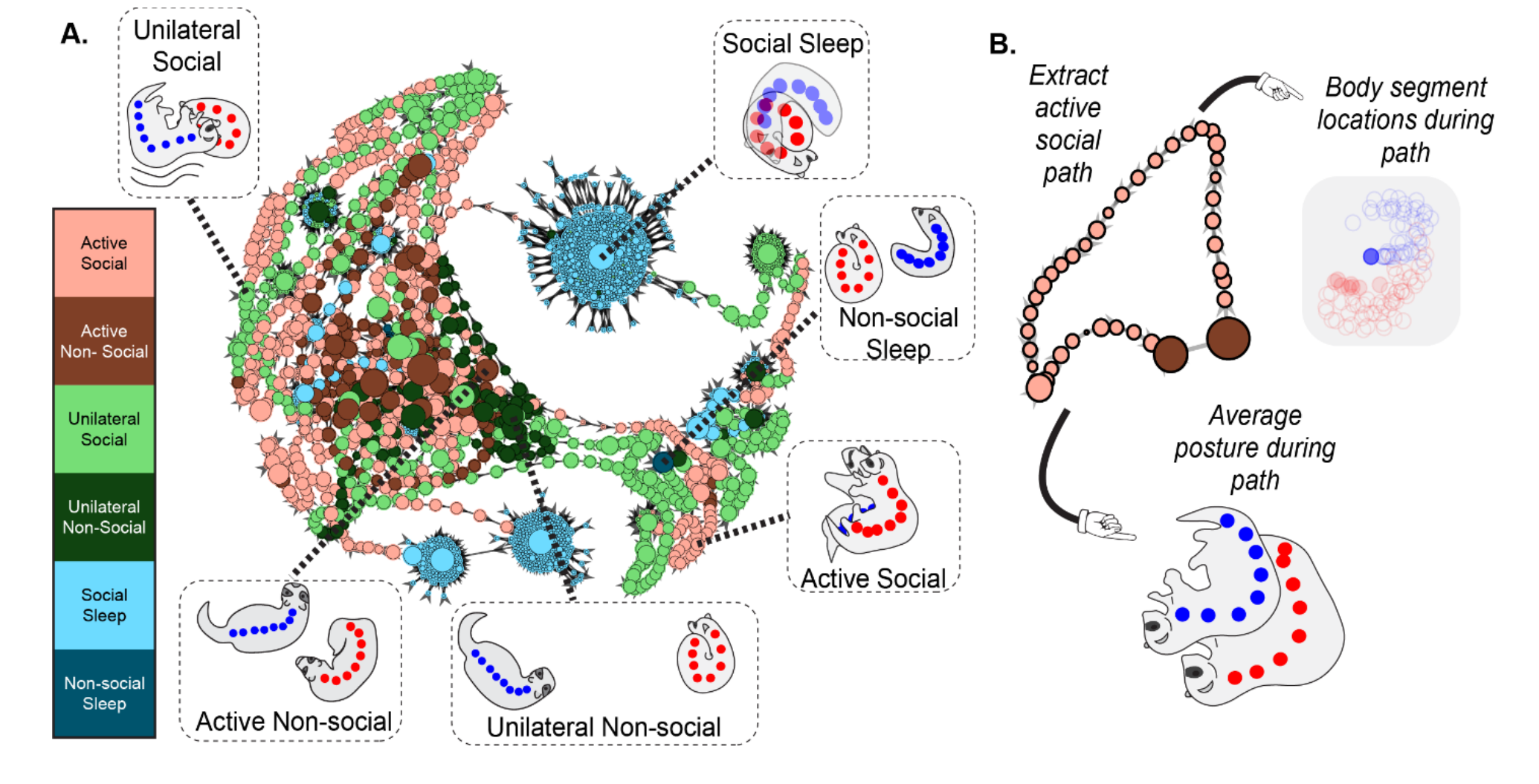
A posture transition network for one ferret session (A), built from DeepLabCut pose-tracking alone; nodes are postural states colored by behavioral category and sized by dwell time — social states (salmon/green) spread to the periphery while non-social states cluster centrally. (B) An active-social path extracted from the network, and the average posture along it. Adapted from Reiling et al. (2026), Figure 3 (CC BY 4.0).
Using it on your own data
The sample data shipped with the toolbox — historical East Lansing weather — is itself a non-neural example, included precisely to show that the method is general. To apply Temporal Mapper to your own system, arrange your data as rows = time points and columns = state variables, build a distance matrix, and run the two-step pipeline described in the Quickstart.
References
-
Zhang, M., Chowdhury, S., & Saggar, M. (2023). Temporal Mapper: transition networks in simulated and real neural dynamics. Network Neuroscience, 7(2), 431–460. https://doi.org/10.1162/netn_a_00301 (CC BY 4.0) ↩
-
Luo, X., & Zhang, M. (2026). A topological data analysis method for revealing dynamic changes in psychotherapy microprocesses. Frontiers in Psychology, 16, 1711782. https://doi.org/10.3389/fpsyg.2025.1711782 (CC BY) ↩↩
-
Reiling, J., Padilla-Coreano, N., Patel, D., Frohlich, F., & Zhang, M. (2026). Topological data analysis captures complex behavioral dynamics during naturalistic social interaction between domestic ferrets. bioRxiv 2026.07.01.735818 (preprint). https://doi.org/10.64898/2026.07.01.735818 (CC BY 4.0) ↩